

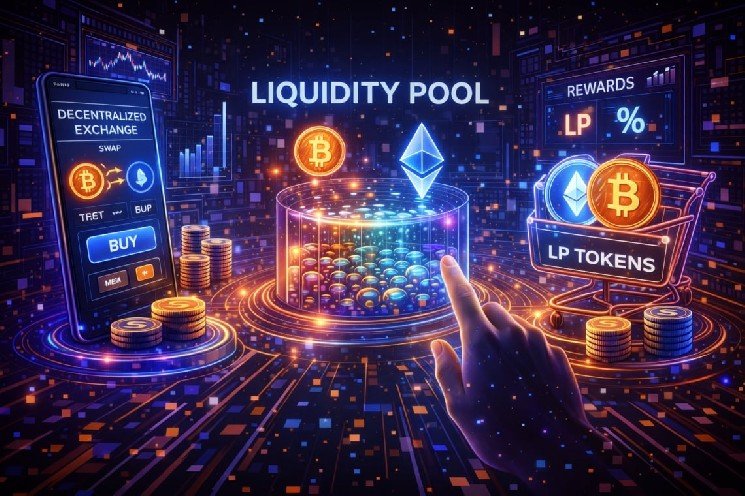
Decentralized crypto exchanges (DEXs) are based on liquidity pools.
These pools operate trading pairs between cryptocurrencies, allowing one token to be exchanged for another on-chain in a peer-to-peer manner thanks to smart contracts on blockchains such as Ethereum, BNB Chain, and Solana.
In other words, anyone holding tokens on a particular blockchain can exchange them for other users’ tokens using a DEX on the same blockchain.
However, while it looks relatively simple from a theoretical perspective, it is anything but from a technical perspective.
liquidity pool
Traditional centralized exchanges have so-called order books. Each buy or sell order is entered into the order book and waits for a matching counter order. When two perfectly matched opposing orders (one sell and one buy) are found in the order book, the exchange automatically executes the trade.
However, since there is no order book in a DEX, a different, slightly more complex technique must be used.
In fact, the majority of modern DEXs use the so-called AMM (Automated Market Maker) model, which is based precisely on liquidity pools. These are nothing but smart contracts containing pairs of tokens deposited by users.
Therefore, instead of an order book where orders are placed, there is a liquidity pool of individual trading pairs to which tokens are sent directly.
Once these tokens are sent to the liquidity pool, they are effectively locked into a smart contract, and it is the AMM algorithm that determines the exchange price and executes the swap.
Technically, when a user requests to exchange one token for another, he or she is effectively depositing the token into a liquidity pool and, after the exchange, can withdraw the other token from the same liquidity pool.
liquidity provider
The problem is that for the exchange to take place, the other token, the token that the user wants to receive in exchange for his, must already exist in the liquidity pool.
In fact, the people who deposit their tokens into liquidity pools are called liquidity providers (LPs), and they make money by receiving a portion of the fees generated from the swaps in the pool. They often also receive additional rewards distributed to incentivize liquidity providers.
Therefore, becoming an LP is a way to generate passive income, although it comes with certain risks.
First and foremost, liquidity providers earn passive income from a percentage of the fees on each trade in the liquidity pool. With larger pools, you can potentially earn higher APYs.
Additionally, many DEXs accept the DEX’s native token as an incentive.
What’s interesting is that anyone can become an LP with their own wallet, without KYC.
How to become a liquidity provider
First, make sure you have a non-custodial wallet that you can connect to your DEX.
Note that each DEX is based on a blockchain, so you need to make sure your wallet is compatible with your DEX.
Additionally, you must also ensure that you have enough fees in your wallet to cover the cost of the transaction (commonly known as gas).
Fees are paid in the native crypto of the blockchain you wish to use.
At that point, you can connect your wallet to the DEX by following its specific steps (which are usually very similar across different decentralized exchanges).
Now comes the most “challenging” part.
To act as a liquidity provider within a liquidity pool, both tokens of the trading pair you wish to trade must be held in your wallet at the same value.
Therefore, simply connecting your wallet to a DEX is not enough. You also need to make sure you have enough funds to operate as an LP on a particular trading pair.
Only at that point can you proceed further with adding actual liquidity to the pool.
On a DEX, you need to look for a “pool” or “liquidity” option or something similar, select the trading pair you want to operate as an LP, and enter the amount of tokens you want to use.
At this point, all you have to do is submit your tokens, confirm the transaction, and confirm the addition of your tokens to the liquidity pool.
revenue
When tokens are locked into a liquidity pool, they receive LP tokens in return, representing a share of the liquidity in the pool.
Every time someone executes a trade on a specific trading pair within the selected DEX, profits are automatically accumulated.
There are tools you can use specifically to track your earnings, such as DeBank and Zapper.
Obviously, tokens locked within a liquidity pool can be withdrawn at any time. To withdraw them, you will need to exchange some of your LP tokens to redeem them. This operation burns the returned LP tokens, removes the liquidity from the liquidity pool, and transfers it to your wallet.
advantage
The first obvious benefit is that you can earn yield on your tokens.
While it is true that you need tokens from both cryptocurrencies in your chosen trading pair, the APY can become very attractive if you choose a pair with very high trading volumes.
Moreover, you can withdraw funds from the liquidity pool at any time, so as long as everything works correctly, there is theoretically no particularly high risk.
Finally, in this way we contribute to the DEX ecosystem and contribute to the efficiency of the DEX ecosystem by reducing slippage for traders.
risk
The biggest risk is so-called permanent loss.
When the relative price of the tokens in the pool changes compared to the price at the time of deposit into the pool, the AMM algorithm automatically rebalances the pool by selling tokens that have increased in value and buying tokens that have decreased in value.
This means that in the case of withdrawals, you will end up with more tokens that have fallen in value, but fewer tokens that have appreciated in value. In fact, you will lose money compared to simply holding the tokens.
However, this is a “permanent” loss because the loss disappears once the price returns to its original level. However, if you withdraw during a divergence, your losses are effectively permanent.
Furthermore, temporary losses increase with volatility, so it is important to pay close attention to trading pairs, especially those with high volatility.
Additionally, there are other typical risks associated with decentralized smart contracts.
First of all, if a smart contract is not executed properly, it can be attacked and compromised by hackers, who can successfully steal all your funds.
Additionally, if there is a problem, your funds may be frozen, making it difficult to withdraw them.
Finally, if on-chain fees become high at a certain point, these can effectively become additional costs that are not necessarily anticipated.
It should also be noted that new token liquidity pools are often exposed to additional risks. This means that the team behind the launch may run out of liquidity at some point and the value of the token will decrease significantly.
So, while becoming a DEX liquidity provider is certainly an opportunity, it requires education and risk management. Additionally, it’s always important to assess whether the risk is worth the effort.


