


While global platforms such as Polymarket and Kalshi are still blocked by Japan’s strict gambling laws, prediction markets are quietly taking root through domestic startups. Their model borrows the same workarounds that have allowed Japan’s $100 billion pachinko industry to operate for decades.
Global prediction market platforms cannot legally operate in Japan, but that hasn’t stopped prediction markets from emerging. Domestic startups are employing the same legal workarounds that have allowed Japan’s pachinko industry to operate for decades.
The Miraima app is a great example of this trend. The app is only seven months old and already attracts 1 million monthly users. The platform allows users to bet on sports, stocks, and political events using points rather than cash. Prizes can be redeemed individually through gift cards and retail rewards programs (primarily PayPay and Rakuten).
Digitization of pachinko models
This structure is well known to anyone who knows the Japanese pachinko industry. Rather than paying cash directly, pachinko parlors award physical tokens that are exchanged for money through another business.
Prediction market startups are applying the same principles to digital. Users stake points within the platform, but rewards are redeemed individually through third-party loyalty programs.
“Gambling with real money is not possible, so we built our platform around Japan’s strong gaming and point-collecting culture,” Miraima founder Keita Adachi told Bloomberg.
Miraima calls itself “Japan’s first” predictive market and point activity app. The company says in its social media bio that users can predict outcomes in areas such as politics and sports without placing any money on the line, and redeem correct predictions for gift certificates.
The product presentation also points in the same direction. Miraima displays event probabilities, market charts, trending topics, and sports categories in a format much similar to established prediction market platforms such as Polymarket.
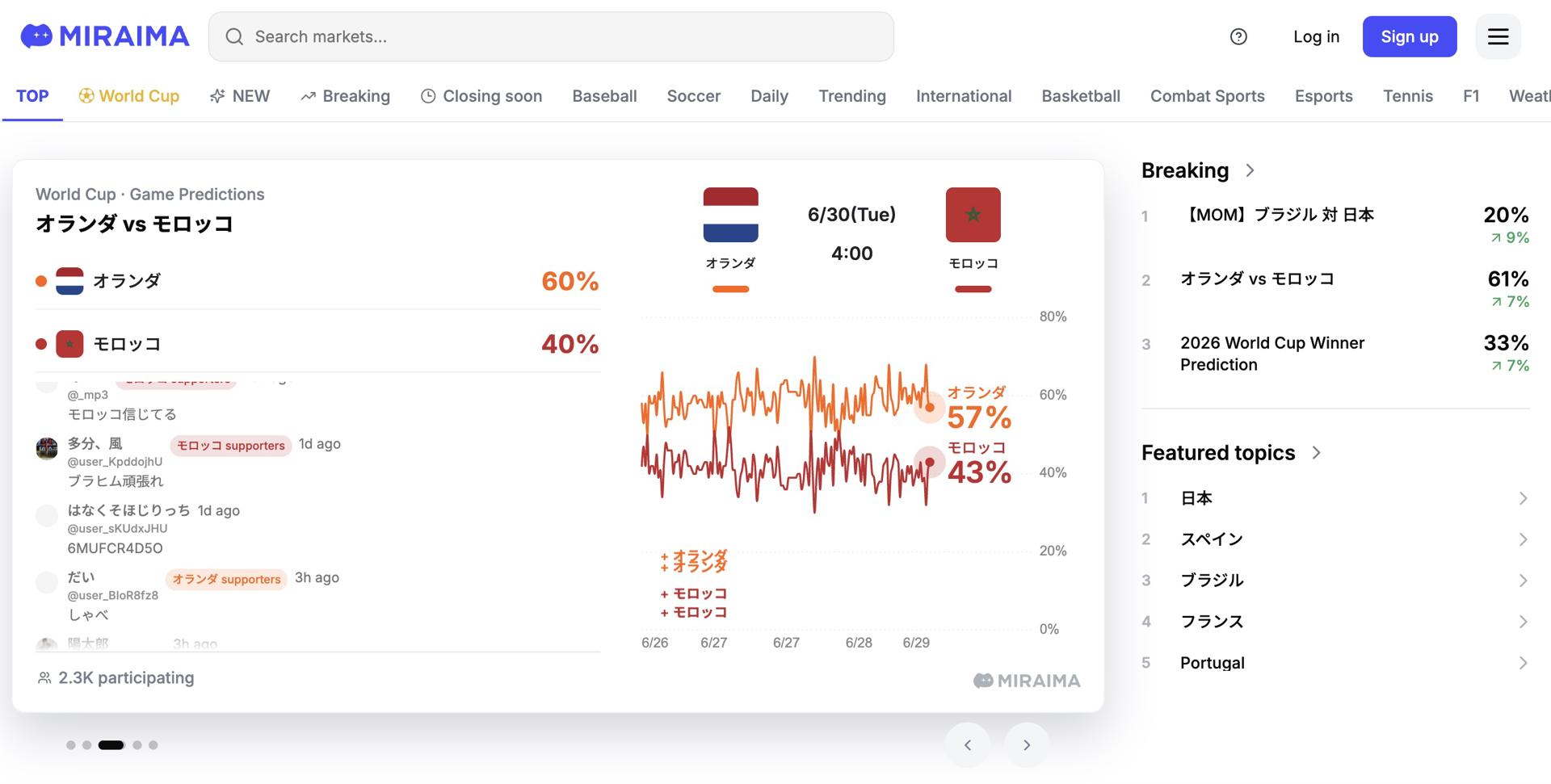
Screenshot of Miraima app interface
International platforms follow different routes
International carriers are responding differently to Japan’s regulatory environment. Polymarket recently appointed former Jupiter Japan president Mike Eidlin to lead its domestic efforts.
The company has announced 2030 as its target for regulatory approval, coinciding with the opening of Japan’s first integrated casino resort, MGM Osaka.
Elsewhere, Polymarket and Kalsi continue to accommodate users in India, despite India’s evolving regulatory environment. In contrast, Japan remains a market where neither platform currently operates directly.
What it means for brokers
Japan is still closed to traditional prediction market products. At the same time, the rapid growth of points-based platforms suggests that demand for event-based trading already exists under the current legal framework.
This model is based on an important legal distinction. Users do not officially place bets or receive cash directly through the platform itself. Lawyers following the market say the distinction remains defensible under current law, but future enforcement could ultimately test its interpretation.
Japan is also increasing the Casino Management Commission’s 2026 budget while expanding its digital surveillance capabilities. Whether points-based prediction markets continue to operate under the existing framework or become part of a future regulated market will depend on how regulators choose to apply existing gambling laws.


