


Morgan Stanley announced on June 5 that eligible wealth management clients can now lend Bitcoin, Ethereum or Solana to Galaxy Digital and receive shares of spot crypto exchange-traded products in return.
Galaxy will coordinate physical creation with approved participants and deliver ETP shares directly to the client’s selected account. Onboarding timelines that previously exceeded four weeks can be reduced by up to 75%.
For customers referred by Morgan Stanley, Galaxy has lowered the minimum deal amount from $25 million to $5 million.
The U.S.-traded Spot Bitcoin ETF posted a historic $4.4 billion in net outflows for 13 consecutive weeks ending in early June. Bitcoin has fallen about 53% from its October 2025 high of around $126,200, reaching $60,000 at one point this week.
Against this backdrop, Morgan Stanley’s deal provides high-net-worth clients with direct holdings of coins that are integrated into the bank’s portfolio structure, marginable, reportable, and have access to the same infrastructure that already supports securities lending, margin accounts, and private banking.
The regulatory layer that made this possible
In July 2025, the SEC approved the in-kind creation and redemption of crypto ETPs, removing a central structural obstacle.
This change allows authorized participants to create and redeem Spot Crypto ETP shares using the underlying crypto assets, making it work closer to how commodity ETPs already work.
Galaxy can now take customers’ BTC, use it to create physical ETP shares, and deliver those shares without making a taxable sale of the underlying assets. Under the previous rules, this workflow required round-trip cash conversion.
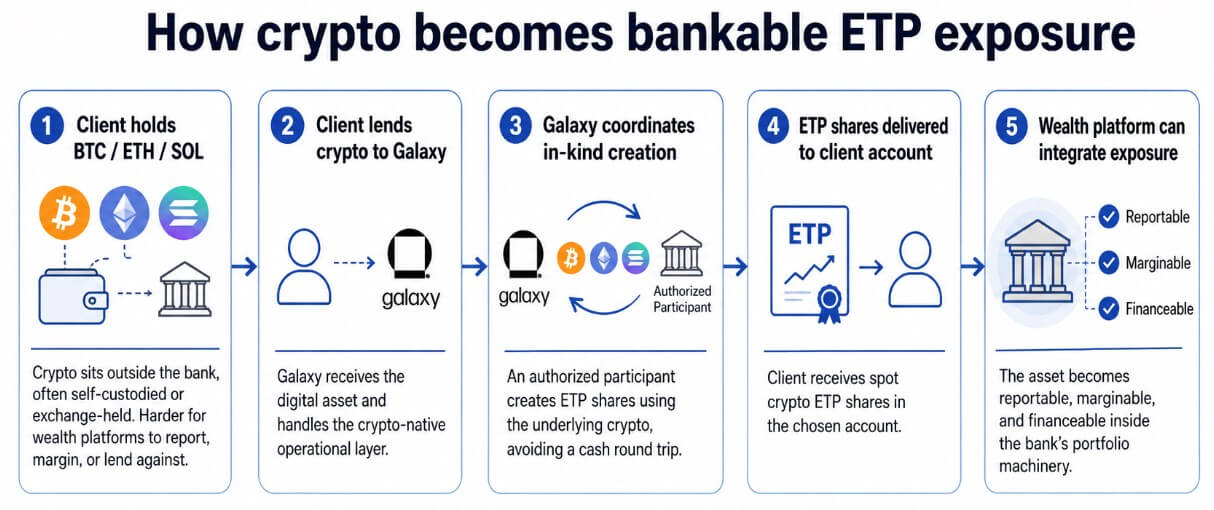
Morgan Stanley has limited its role to introductions and customer education, while Galaxy oversees onboarding and has exposure to cryptocurrency operations.
This division will allow Morgan Stanley to remain on the regulated securities side of the transaction while Galaxy will take operational risk into cryptocurrencies.
External crypto assets, previously held in self-custody or on exchanges, can be moved into bankable portfolios, serve as margin collateral, and integrate with reporting and lending services.
Three models for three theories
Morgan Stanley’s arrangement falls within broader institutional differences over what forms of crypto exposure banks can safely recognize, with three models currently running in parallel.
The first is ETP collateral, which is the most bank-friendly form because banks understand how to price, store, margin, and liquidate registered securities. JPMorgan moved here first, accepting BlackRock’s IBIT stock as collateral for a loan before expanding further.
Morgan Stanley and Galaxy’s agreement extends this model by converting cryptocurrencies held outside banks into ETP shares, which will be integrated into existing asset management, margin and lending workflows.
The second model is direct crypto collateral and represents a larger structural leap. JPMorgan had planned to allow institutional clients to directly pledge BTC and ETH against loans by the end of 2025, with collateral assets held by third-party custodians. The bank has not publicly confirmed which products are actually in operation, and the situation remains based on reported plans.
| model | banking comfort level | Main asset types | Example from article | What banks like | Main risks |
|---|---|---|---|---|---|
| ETP collateral | expensive | Spot Bitcoin/Virtual Currency ETP Share | Morgan Stanley/Galaxy; JP Morgan accepts IBIT collateral | Familiar securities wrappers, custody, pricing, and margins | ETF outflows propagate selling by institutional investors |
| Direct cryptocurrency collateral | medium to low | Directly collateralize BTC/ETH | Report on JP Morgan’s BTC/ETH Collateral Plan | More direct use of cryptocurrencies as balance sheet collateral | Volatility, custody, margin calls, liquidation rights |
| Tokenized Collateral Alternative | rising | Tokenized government bonds, MMFs, and deposits | Standard Chartered/OKX/BlackRock BUIDL; HSBC Tokenized Deposit | Collateral leg with high yield and low volatility | Payment, legal and platform interoperability risks |
Once operational, banks will treat BTC and ETH in the same way they already treat listed stocks in margin accounts, with real-time valuations, haircuts, and automatic margin calls.
A loan that starts at 50% loan-to-value becomes a 71% LTV loan after a 30% Bitcoin drawdown. A 50% drawdown would take the same loan to 100%, completely erasing the collateral.
The $1.8 billion in forced crypto liquidations recorded on June 3 alone is the largest single-day figure since February 2026 and shows what leverage can create in high-velocity markets.
The third model, tokenized collateral substitution, may prove to be the most durable. While banks prefer tokenized US Treasuries and money market funds as collateral, cryptocurrencies remain as traded risk assets.
On April 28, OKX, BlackRock and Standard Chartered launched a framework that allows institutional investors to pledge BlackRock’s BUIDL tokenized Treasury funds as yield-bearing margin collateral to OKX, with Standard Chartered acting as the first G-SIB custodian in such an arrangement.
Customers can earn yield on the collateral they would otherwise have idled, and Standard Chartered handles regulated off-exchange custody, keeping assets separate from the exchange’s own holdings.

What banks are actually building
Standard Chartered’s off-exchange model with OKX means that crypto-native trading venues will require a regulated G-SIB wrapper to attract the most cautious institutional investors.
BNY is building a digital asset platform that combines custody, collateral management, lending, payments, and 24/7 liquidity rails, positioning it as the infrastructure foundation upon which crypto lending and tokenized asset markets will operate.
Citi frames its role around payments, storage of stablecoin reserves, and crypto ETF custody services, and claims its role is plumbing.
All major banks are competing to control the wrapper, custodian, collateral agent, or service infrastructure around which Bitcoin circulates.
Two paths through the same pipe
In a bullish case, regulatory clarity and stronger custody controls will normalize the use of BTC and ETH as collateral for institutional investors.
According to Citi’s June 2026 Tokenization Report, global tokenized assets are currently around $17 billion, with a bull case forecast of $8.2 trillion in 2030.
If this trajectory holds, crypto collateral will become a routine feature of bank lending, tokenized US Treasuries will grow as the preferred institutional margin asset, and Bitcoin will become even more useful as a balance sheet vehicle.
The pipeline that Morgan Stanley and Galaxy are assembling will be expanded at scale across private banking, bringing self-custodial assets into managed portfolios where they can be funded, reported and deployed.
In the bearish case, volatility and operational risk will keep banks locked into the ETP wrapper. Direct Bitcoin collateral programs remain narrow in scope, have high haircuts, and have limited reach beyond a narrow institutional base.
Banks rely on tokenized U.S. Treasuries and deposits, and while HSBC will expand tokenized deposit services to U.S. customers in April 2026, enabling 24/7 on-chain funds movement without public chain settlement risk, raw BTC lending remains limited to a small number of crypto-native lenders and hedge funds.
Bitcoin ETF outflows have become a recurring phenomenon as regulated wrappers attract capital and it flows out the same door when sentiment changes.
leverage loop
Neither scenario eliminates the structural impact of the collateral itself.
Galaxy Research estimated that crypto-backed lending will reach $73.59 billion in Q3 2025, split between DeFi lending (55.7%), CeFi (33.1%), and crypto-backed stablecoins (11.2%).
As banks expand from ETP collateral to direct BTC and ETH lending, Bitcoin price movements will increasingly reflect institutional deleveraging cycles.
The $4.4 billion spot ETF outflow that pushed Bitcoin below $60,000 this week shows how quickly regulated wrappers can propagate institutional selling. Adding margin calls on crypto-backed loans directly to that mechanism would result in more drawdowns forcing selling than the market has been able to handle to date.
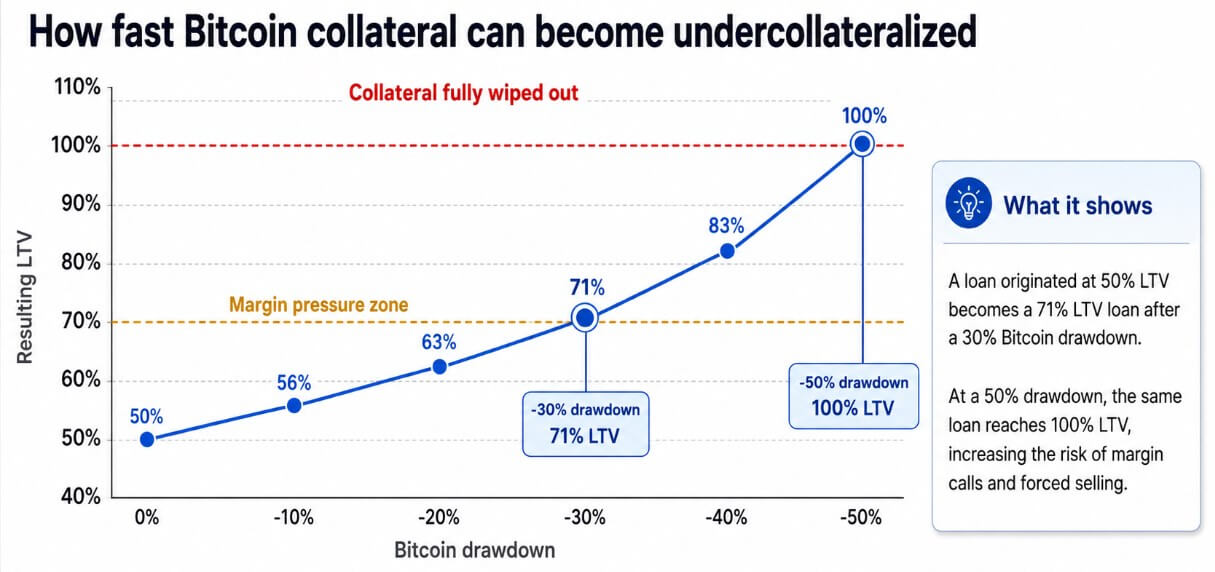
Morgan Stanley’s deal with Galaxy is an asset management funnel. External crypto assets enter banks’ portfolio structures, becoming loanable and reportable, increasing correlation to anything that causes institutional investors to reduce risk.
Bitcoin adoption will be integrated into the same collateral loop that governs all other asset classes, with all the structural appreciation and deleveraging exposure that comes with it.
(Tag translation) Bitcoin


