

927-page application filed more than a year late
The acquisition was disclosed in the president’s annual financial disclosure report. The report, a 927-page spreadsheet document filed with the Office of Government Ethics (OGE) this week, was first reported by NBC News journalists Steve Kopack and Gabe Gutierrez. The transactions appear to be scattered throughout the filing, but none have ever been reported.
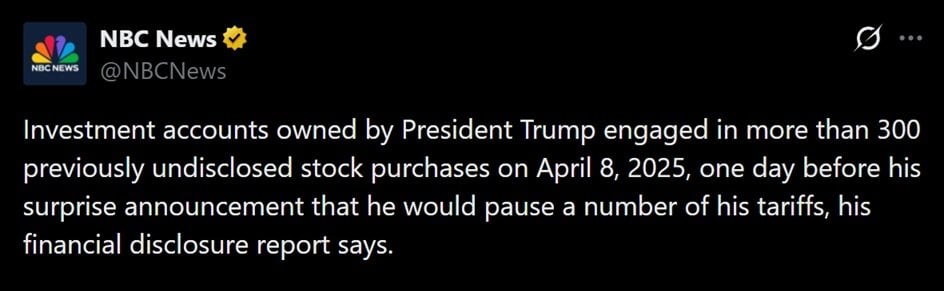
The timing of the development comes as federal ethics laws require senior officials to report securities transactions within 45 days on a periodic transaction report known as Form 278-T. Trump has not filed such reports for his April trades or most of his 2025 trades, meaning the April 8 buying spree has been out of public view for more than 14 months. The maximum penalty for missing the deadline was only $200.
OGE reviewers flagged gaps directly in the document, noting:
“The filer paid late filing fees related to transactions that were not previously reported on the 278-T.”
The trades behind the historic buying day
The 327 individual purchases included stock in Apple, Microsoft, Nvidia, Amazon, and Alphabet, each valued at $250,000, as well as numerous other companies. The actual total is below the $12.8 million cap because federal disclosures report holdings in ranges rather than exact numbers.
The next day, April 9, 2025, President Trump suddenly announced the suspension of some tariffs for “Emancipation Day.” The S&P 500 index then closed up 9.5% (one of the largest single-day gains in the index’s history). The very names of technology that appeared in the president’s financial statements fueled the backlash.
The White House said all of the president’s assets are held in fully discretionary accounts managed by independent third-party financial institutions, an arrangement in which Trump does not personally direct individual transactions. The disclosure itself provides no evidence of who directed the April 8 purchases, and no public agency has accused the president of making the trades with advance knowledge of his policy shift.
Ethics watchdog groups say that’s exactly the problem, with Craig Holman of government accountability group Public Citizen pointing out that:
“It is important that the public and the press have a complete picture of the asset holdings, investments and stock transactions of senior civil servants.”
Surveillance will be strengthened, centering on the market-oriented presidency.
The revelations add another layer to an already crowded ledger, given that Trump’s 2025 disclosure also reported at least $1.4 billion in crypto income, led by memecoin royalties and World Liberty Financial token sales. At the same time, the administration is pushing to modernize federal finances, from a massive digital shift in government payments to the launch of the Trump Account, a children’s savings program that opened on July 4 and is now accepting publicly traded stock donations.
The conflict between personal portfolios and public policy has fueled ongoing criticism because when the officials who set tariff policy own hundreds of stocks that are subject to tariff headlines, the timing of disclosure is no longer a bureaucratic technicality (and the public’s only window into potential conflicts). Watchdog groups argue that a $200 late fee is no deterrent against a 14-month delay.


