



Ethereum is struggling below $1,800 as selling pressure and uncertainty keep the price well below the levels that defined the early stages of the recovery this cycle. This decline was sustained rather than sudden, and CryptoQuant’s data revealed a combination of on-chain signals that reveal the behavioral dynamics underlying price action in a way that refutes both the simple bullish and bearish readings currently in circulation.
This analysis looks at three metrics simultaneously: Retail Address Accumulation, SOPR, and NUPL to build a complete picture of market sentiment rather than pricing mechanics. What this picture makes clear is that the market is caught between two forces pulling in opposite directions.
Ethereum retail accumulation surged to near-record levels in late 2025 and early 2026. The intuitive interpretation of this surge is bullish. More buyers at lower prices should support the recovery. However, the historical context that CryptoQuant data provides quickly complicates its interpretation. Historically, the highest levels of retail purchasing activity have been seen in the later stages of a market cycle, just as large participants begin to allocate their holdings to demand.
Record retail accumulations are not automatically a bullish signal. It completely depends on who is on the other side of those purchases.
A second layer of vulnerability is added when SOPR hovers around 1.0 for an extended period of time. Investors are not realizing meaningful gains or experiencing significant losses. This is a neutral state that reflects limited fresh capital flowing into the market and a price structure that has not yet resolved in either direction. If SOPR remains at this level for too long, the market becomes vulnerable to certain types of breakdowns created by loss-driven selling pressure.
A market where you can’t find a floor
CryptoQuant analysis adds a NUPL dimension that completes the bearish case without making it absolute. Unrealized gains across the Ethereum holder base have fallen significantly from cycle highs, but are still above the extreme levels recorded in the 2018 and 2022 bear markets. The distance from historic lows means further selling pressure could remain if conditions continue to deteriorate. In terms of revenue depletion, the worst is not yet priced in.

Ethereum Accumulating Retail Adress | Source: CryptoQuant
The most alarming signal in this analysis is the divergence between cumulative price and price. While market forces remain weak, retail investors are actively purchasing Ethereum. When exceptional demand growth does not result in price increases, the explanation is almost always the same. This means that there is massive selling pressure on the other side that is systematically absorbing all retail purchases. The whales appear to be distributed in the strongest retail purchasing market in recent years.
Binance users’ deposit addresses remaining below the previous bull market peak provides a partial offset that prevents the situation from turning completely bearish. Many ETH holders are still holding their coins instead of sending them to exchanges, which is slowing the decline rather than stopping it.
The forward risks identified in the report are specific and conditional. A SOPR below 1.0 confirms that investors are primarily selling at a loss. This is the trigger for the loss-driven selling pressure that has historically fueled Ethereum’s most damaging declines. Combined with the weakening of NUPL, this would remove any remaining buffer between the current price structure and the kind of capitulation that the 2018 and 2022 bear markets will ultimately require before a true bottom is formed.
Ethereum falls below critical support
Ethereum remains under strong selling pressure after definitively losing the $1,800-$1,850 support area that had served as its last line of defense since February. The daily chart shows a clear breakdown from the multi-month distribution range, with ETH trading around $1,760 after a sharp rejection from the $2,300 resistance zone that limited all recovery attempts from April to May.
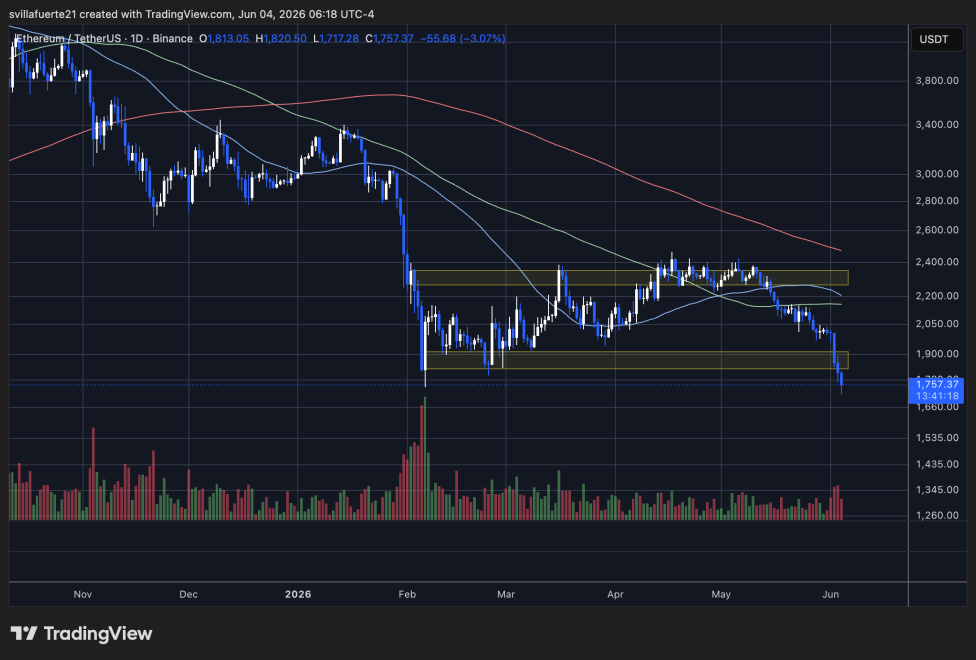
Ethereum trading below $1,800 level | Source: ETHUSDT chart on TradingView
The technical damage is enormous. Price is currently below all major moving averages, and the 50-day, 100-day, and 200-day trends are aligned in a bearish direction. More importantly, ETH fell below the lower bound of the consolidation structure that contained price action for about four months. The increased volume during the decline suggests seller conviction rather than a temporary liquidity event.
The next major area of interest is between approximately $1,700 and $1,750. This zone marks the lower end of the chart’s current demand area and represents the last significant support before Ethereum risks revisiting February’s capitulation lows. The Bulls need to aggressively defend this area to prevent deeper adjustments.
On the upside, the previous support zone around $1,850-$1,900 provides immediate resistance. If it attempts a recovery, it will first need to regain that level before a move toward $2,050 becomes realistic. Until then, the trend remains bullish, with lower highs, lower lows, and deteriorating momentum continuing to favor sellers, despite increasing oversold conditions.
Featured image from ChatGPT, chart from TradingView.com
editing process for is focused on providing thoroughly researched, accurate, and unbiased content. We adhere to strict sourcing standards, and each page is carefully reviewed by our team of top technology experts and experienced editors. This process ensures the integrity, relevance, and value of your content to your readers.


