


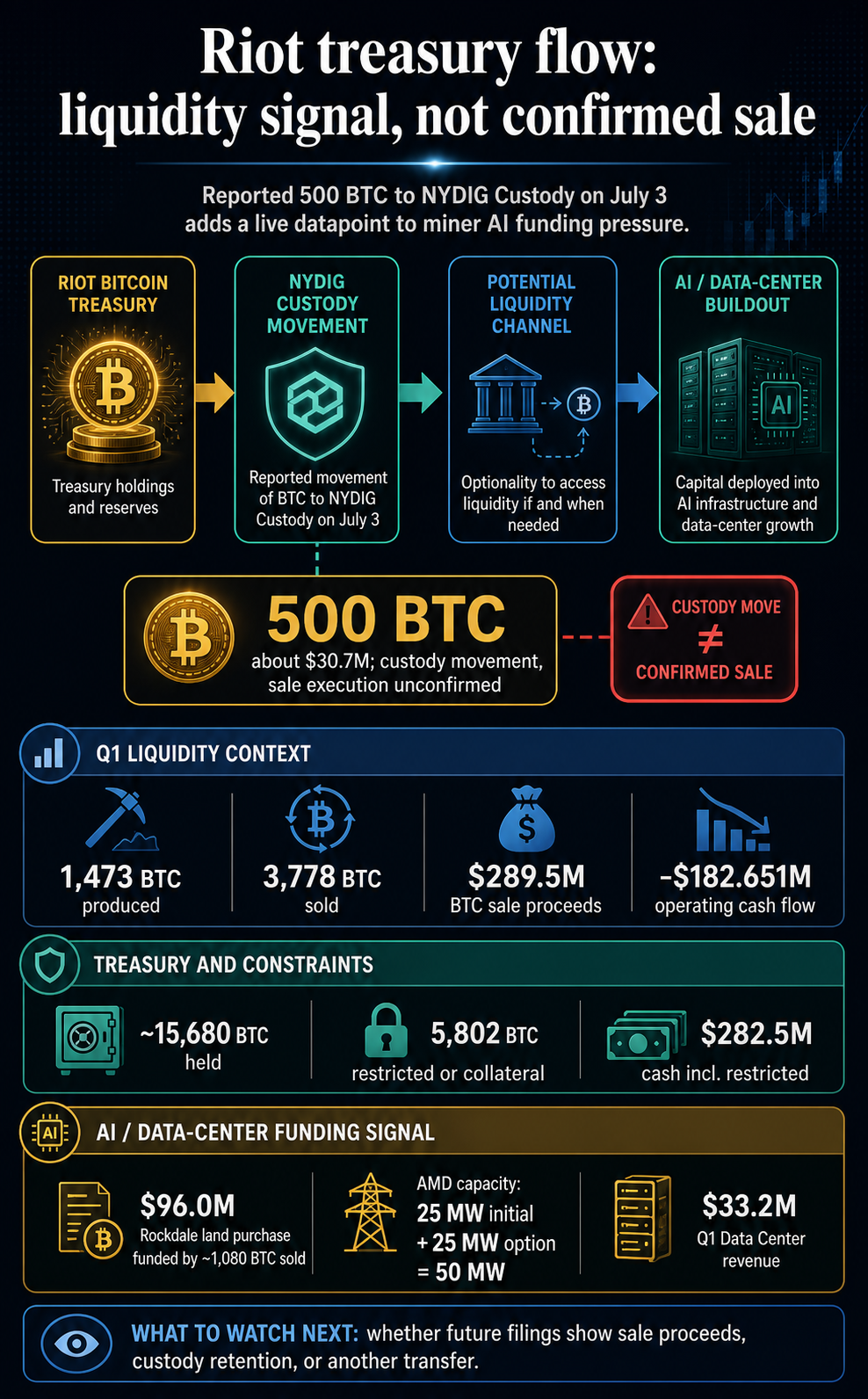
Riot Platforms’ reported 500 BTC move to NYDIG Custody gives the market a raw signal on how public miners will utilize coin vaults as AI and data center costs rise.
PANews reported on the July 3 transfer, citing on-chain monitoring data, valuing the move at approximately $30.7 million. Available records support storage transfers but do not indicate sales made or sales proceeds.
This difference makes the signal useful. With Riot already disclosing Bitcoin sales, collateral limits, negative operating cash flow, and data center expansion plans, the new large-scale custodial move is emerging as a capital allocation indicator rather than regular wallet maintenance.

Why is a one-time transfer of custody now more important?
Looking at Riot’s Q1 numbers, it’s hard to dismiss the 500BTC move as wallet maintenance. In its Q1 production update, the company revealed that it produced 1,473 BTC during the quarter and sold 3,778 BTC for a net profit of $289.5 million, with an average net price per coin of $76,626.
This means Riot sold more than 2.5 times as much Bitcoin as it mined in the quarter. The company still ended the period with a large amount of funds, approximately 15,679 to 15,680 BTC depending on the source line, although Riot’s Q1 materials listed 5,802 BTC as restricted or held as collateral.
First quarter results show $282.5 million in cash on hand, including restricted cash.
The 10th quarter shows how central these sales were to the cash flow picture. Riot reported negative operating cash flow of $182,651,000 for the three months ended March 31, with revenue from Bitcoin sales of $289,484,000. This sale facility was one of the primary cash flow offsets in the filing.
In that context, another 500 BTC movement reported to NYDIG serves as a live liquidity marker. Although the sale execution of this batch has not yet been confirmed, this move gives the market another fund flow data point to compare with Riot’s production, sales, cash, and restricted Bitcoin disclosures.
| Riot liquidity data points | Reported figures | signal |
|---|---|---|
| BTC generated in Q1 | 1,473BTC | Baseline mining output |
| BTC sales in Q1 | 3,778BTC | Sales exceeded quarterly production |
| Q1 BTC Sales Revenue | $289.5 million | Large source of funds during the quarter |
| Operating cash flow for the first quarter | -$182,651,000 | Pressure ahead of funding and investment flows |
| BTC holdings at end of quarter | Approximately 15,679~15,680BTC | Riot still had a large Bitcoin vault |
| Limited BTC or Collateral BTC | 5,802BTC | Some in the Treasury were already tied to loans and restrictions. |
| Rockdale land purchase | Raised $96 million by selling approximately 1,080 BTC | Direct precedent for turning BTC into data center infrastructure |
| Recently reported NYDIG movements | 500 BTC, approximately $30.7 million | New signal to watch, sale execution unconfirmed |

AI pivot changes financial calculations
Alongside its Bitcoin mining roots, Riot is positioning itself as a power-intensive digital infrastructure company. In its first quarter filing, the company described its strategic evolution from a Bitcoin mining-focused company to a diversified data center and digital infrastructure company. The application specifically mentions purposes for large-scale data centers, including AI and high-performance computing applications.
Riot’s Rockdale announcement in January directly tied the monetization of the Bitcoin treasury to its expansion. The company said its $96 million fee-only acquisition of 200 acres in Rockdale was fully funded by selling approximately 1,080 BTC from its balance sheet.
In the same announcement, Riot revealed a data center lease and services agreement with AMD for an initial 25 MW of significant IT load capacity and expansion potential.
By April, Riot announced that AMD had exercised an option for an additional 25MW, bringing the contracted capacity to 50MW. Riot also reported first-quarter data center revenue of $33.2 million, which was primarily comprised of tenant equipment services revenue.
This combination changes the way minor balances are interpreted. Bitcoin miners who sell coins to cover day-to-day operating costs send a signal of sorts. A miner sends another miner to mobilize coins while converting a power plant into an AI infrastructure. This signal extends beyond immediate supply pressures to capital allocation.
Recent firememecoins sector coverage has tracked a similarly broad split, with publicly traded miners drawn between Bitcoin exposure, debt-financed AI infrastructure, contract power valuation premiums, and Treasury monetization.

Riot’s new NYDIG-related transfers are unique because their trends are tied to current wallet-level data points and companies that have already disclosed that they are using Bitcoin sales to develop Rockdale.
For Riot, balance sheet issues are becoming more tangible. While the company still has significant exposure to Bitcoin, some of that exposure has already been sold, restricted, pledged, or converted into land or data center capacity. Each new large-scale storage move is therefore embedded in a different capital allocation story than a simple mining update.
Cadence determines market signals
The easiest mistake is to treat each miner’s transfer as a hidden sell order. This transfer supports storage and potential sale staging signals until Riot or subsequent transaction evidence indicates a final use for the coins. This accessible record of the latest 500 BTC movement allows for sale execution.
This type of repeating movement is even more significant when it follows a disclosed Treasury sale. Riot’s Q1 pattern already shows production, sales, collateral, cash needs, and data center capex interacting within the same balance sheet. Once NYDIG-bound remittances establish a steady rhythm, the market may begin to treat minor government bonds as active liquidity infrastructure rather than dormant reserves.
In the case of Bitcoin, this shifts the issue from the movement of a single 500 BTC to the actions of public miners under capital pressure. Miners are on the verge of new issuance, have significant power and equipment obligations, and are currently competing for AI infrastructure capital.
For Bitcoin’s broader spot market, a single 500 BTC transfer is a small signal compared to daily trading volume. It will be hard to ignore the repeated rhythms of large public miners.
For Riot, the next information disclosure is more important than just the transfer. Future production updates, 10-Qs, 8-Ks, or investor presentations may indicate whether this 500 BTC ends up as sales proceeds, remains in storage, or is moved again. Until then, the conditional conclusion is clear. Bitcoin bonds are increasingly becoming part of the funding source for miners looking to become infrastructure companies in the AI era.
The market already understands why the transfer is attracting attention. Riot used Bitcoin to fund a data center pivot, sold more Bitcoin than it mined in a quarter, and operates in areas where power capacity is valuable but still needs cash to ramp up.
(Tag translation) Bitcoin


