


Digital infrastructure company Soluna Holdings reported a strong first-quarter revenue increase as expansion of its data center operations offset lower profits from crypto mining.
The company’s earnings report released Monday showed revenue of $9.4 million, up 58% from a year ago and 2% from the previous quarter. This was Soluna’s fourth consecutive quarter of revenue growth.
The gains were driven by additional production capacity coming online at the company’s Dorothy and Kati sites in Texas. Data center hosting generated $6.7 million in revenue, but crypto mining’s contribution was around $2.2 million, down from nearly $3 million a year ago, due to deteriorating economic conditions for Bitcoin mining.
Despite increased sales, Soluna was still unprofitable. Net loss widened to $17.9 million from $10.5 million in the year-ago period. This was primarily due to increases in stock-based compensation, interest expense and financing costs. Adjusted EBITDA loss narrowed slightly to $2.1 million.
Soluna continued to expand its infrastructure footprint, including growth plans for its AI and high-performance computing businesses, ending the quarter with $68.6 million in cash.
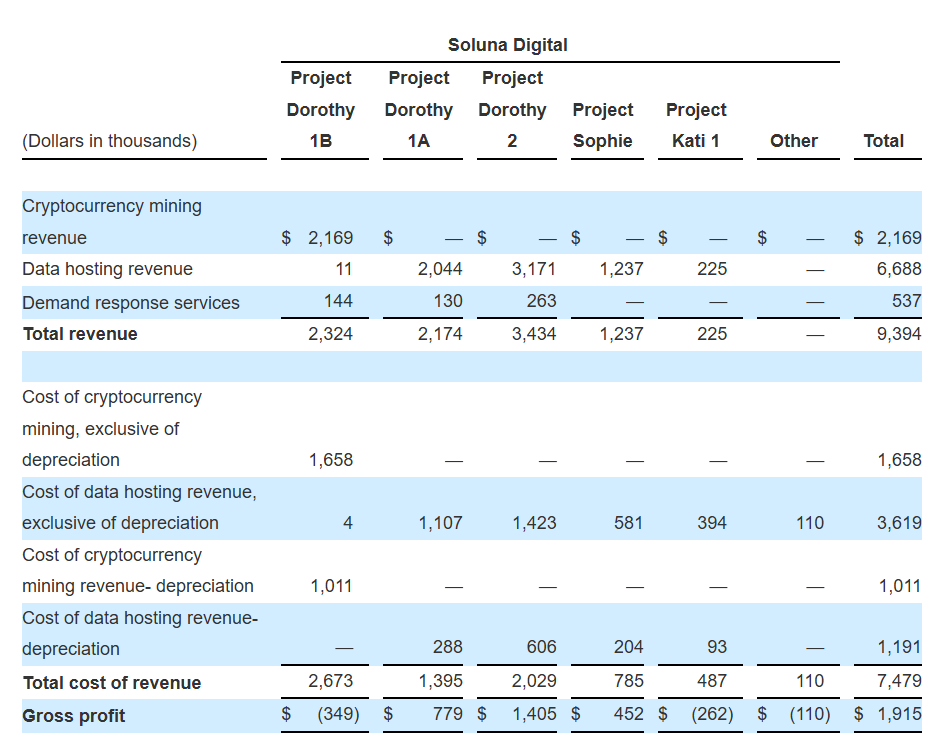
A snapshot of Soluna’s quarterly crypto mining revenue. Source: Solna Holdings
Cryptominers pivot to AI infrastructure
Soluna is participating in a broader shift between Bitcoin ($BTC) As mining margins come under pressure, miners are seeking new sources of income. The mining economy has tightened significantly since the 2024 halving, with recent $BTC Price adds another layer of burden.
A March report from CoinShares found that 20% of Bitcoin miners may be operating at a loss, especially those using older and less efficient machines. The report also noted that Bitcoin’s hash price, a key indicator of miner revenue, fell to post-halving lows in February.
In response, several publicly traded miners, including HIVE Digital Technologies and TeraWulf, have directed capital toward artificial intelligence and high-performance computing.
Bernstein analysts recently said IREN is expected to derive most of its future value from its AI infrastructure rather than digital asset mining. The company cited growth in IREN’s AI cloud business and long-term agreement with Microsoft as key drivers of its transition.
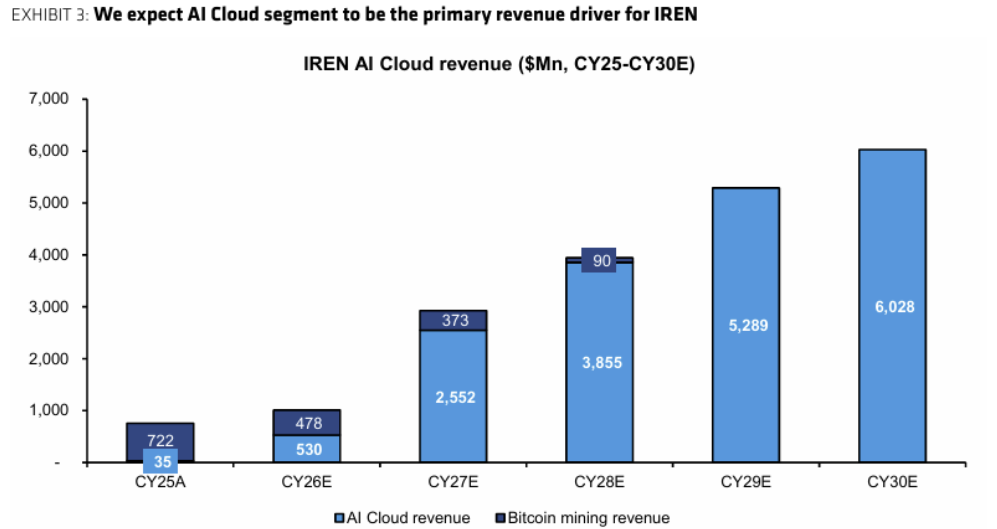
Bernstein’s analysis shows that even large miners like IREN are expected to generate the majority of their revenue from AI. Source: Bernstein


