


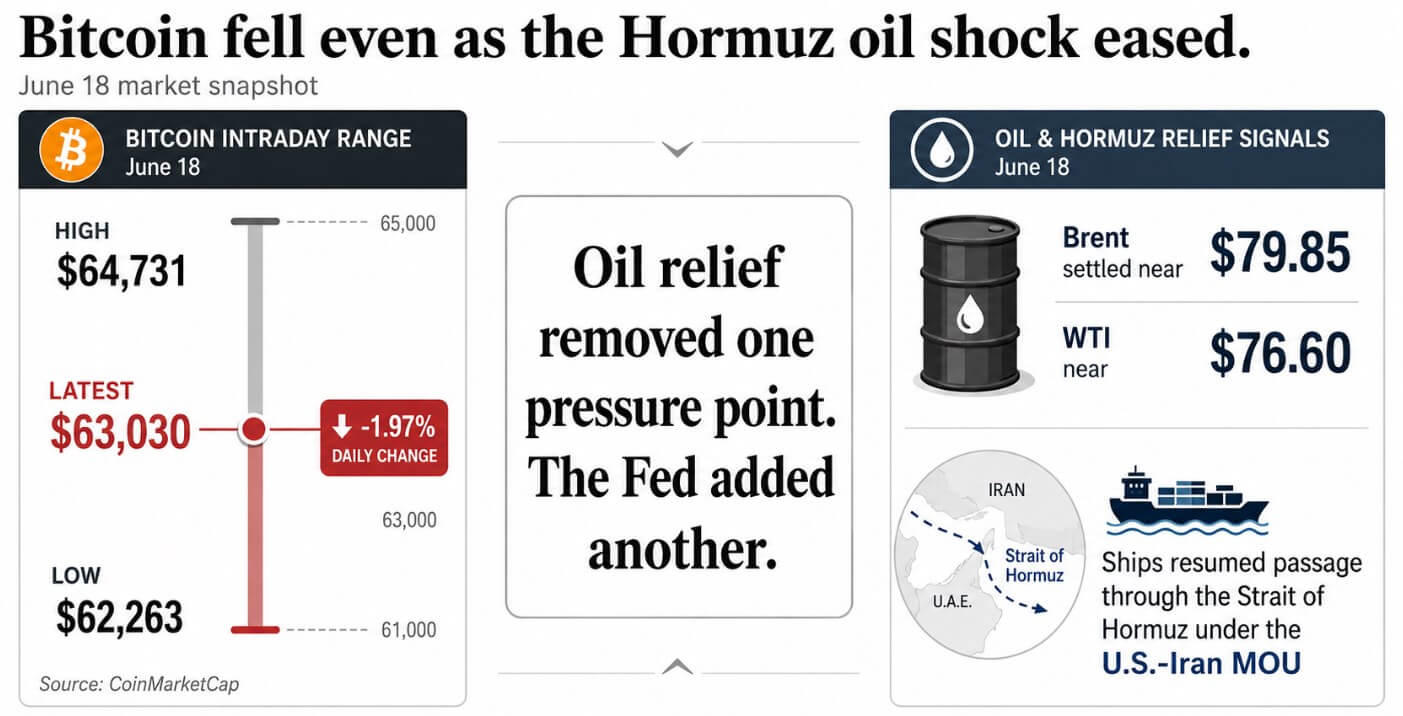
After soaring from an intraday high of $64,731 to a low of $62,263 on June 18, Bitcoin fell about 2% on the day to trade at $63,030 as oil prices fell and ships transited the Strait of Hormuz for the first time in weeks.
As of today, June 19th, price performance has continued to decline since then, approaching $62,450 at the time of writing.
The U.S.-Iran-Islamabad Memorandum, signed by President Donald Trump and sent to Congress on June 18, commits Iran to ensure safe trade in the Strait of Hormuz for 60 days, while the U.S. commits to completely lift the naval blockade of Iranian ports within 30 days.
Hours after President Trump signed the deal, three Saudi-flagged supertankers carrying 6 million barrels of crude oil sailed through the strait, with the vessels once again making their locations public after weeks of hidden voyages.
Brent hit its lowest since before the start of the war on February 28, settling around $79.85, while WTI settled at $76.60. The strait, which is responsible for about 20% of the world’s oil supply, opened its supply lane for the first time since the conflict began.
Lower oil prices reduce the risk of an energy-driven inflationary impulse, and the standard macro sequence is that inflation expectations ease, putting downward pressure on yields and making long-duration risk assets more attractive for interest rate-sensitive positioning.
The Fed has repriced a problem that oil can’t solve.
On June 18, the FOMC kept its target range unchanged at 3.50%-3.75%, but the dot plot was so hawkish that it overwhelmed the oil signal.
According to reports, nine out of 18 Fed policymakers expect at least one rate hike this year, up from zero in March, and six of them expect at least one rate hike of 25 basis points or more.
The Fed’s median year-end PCE inflation forecast rose to 3.6% from 2.7% in March, and the statement said inflation remains above its 2% target and the committee will “achieve price stability.”
The FOMC mentioned supply shocks, including energy, which means the Fed is not yet treating the oil decline as a resolved issue.
After the Fed’s statement, the U.S. dollar index hit a one-year high of 100.80, with federal funds futures pricing in a 68% chance of a rate hike through September.
Bitcoin price action on June 18th shows that while the Hormuz Accord removed one pressure point, the Fed reintroduced a larger pressure point, pushing BTC lower.
| macro channel | what happened | Normal BTC effect | Read on June 18th |
|---|---|---|---|
| holmuz oil | Safe navigation MOU, vessel movement, oil decline | Bullish: Reduces the risk of inflation shocks | Emotions improved, but not enough |
| fed rate | Target maintained at 3.50% to 3.75% | Neutral in headline | Hawkish because the dots shifted |
| dot plot | 9 out of 18 officials expect at least one rate hike | Bearish on liquid assets | It has become difficult to reset the interest rate path |
| inflation forecast | Year-end PCE forecast rises from 2.7% to 3.6% | Bearish if easing is delayed or there is a hint of interest rate hikes | Fed still recognizes inflation problem |
| dollar | DXY hits a one-year high of 100.80 | Bearish on BTC | Global liquidity squeeze |
| federal funds futures | 68% chance of rate hike by September | Bearish on risk period | Overwhelming oil relief |
Today’s low oil prices do not erase the damage caused by inflation and interest rate risks that are already built into the Fed’s policy direction. Policymakers point to rising inflation, nearly half say interest rate hikes are imminent, and the dollar is at a one-year high.
The threat of rate hikes remains in the Fed’s own projections, with policymakers hinting at raising rates if inflation rises above target, but low energy prices are helping at the last minute.
What the shipping data really shows
Shipping and insurance players remain cautious after the deal, with the Lloyd’s Market Association warning that it could be months before things get back to normal.
Mine clearance operations in the straits are incomplete and the 60-day MOU schedule means any resumption is conditional.
It directly affects how Bitcoin is traded on the Hormuz Channel from here on. If the memorandum holds and Brent prices continue to fall toward the mid-$70s, it will be difficult for the Fed to ignore its disinflationary impulses.
Federal funds futures prices will reset, the dollar will lose the support from the interest rate differential that had pushed it to 100.80, and Bitcoin will take a more direct path to recovery.
The war risk premium, which has weighed on risk assets since late February, will truly shrink.
Where Ratepass goes through Bitcoin
If oil prices continue to fall and shipping normalization accelerates faster than Lloyd’s and industry observers expect, disinflationary signals will eventually find their way into the Fed’s inflation forecast.
Bitcoin could regain the $65,000 to $68,000 range as the chances of a rate hike recede, the dollar softens from its one-year highs, and traders reprice the interest rate path rather than war risk.
The Holmes agreement would have done what a bailout deal is supposed to do, only it would have taken longer than one session to be reflected in the macro variables monitored by the Fed.
If the odds of a Fed rate hike continue to rise and the dollar extends the breakout above 100.80, Bitcoin will face pressure that oil bailouts cannot offset.
| scenario | trigger | Impact of Bitcoin | Key level/attention signal |
|---|---|---|---|
| Bull case: oil relief becomes liquidity relief | North Sea Brent continues to fall toward mid-$70s, shipping normalization accelerates, inflation expectations cool | BTC could regain range of $65,000 to $68,000 | Dollar weakens, interest rate hike odds fall, North Sea Brent falls further |
| Base case: FRB wall cap recovery | Oil prices continue to fall, but the probability of a Fed rate hike remains elevated | BTC chops in the low to mid-$60,000 range | DXY is around 100.80, BTC is struggling to maintain between $63,000 and $65,000. |
| Bear case: Fed pressure dominates | Rate hike odds rise, dollar gains, BTC completely loses $62,000 | The $60,000 area comes back into view. | DXY breakout increases probability of September rate hike |
| Risk case: Reversal of Holmes relief | MOUs fray, transportation delays and insurance risks rise again | BTC faces both oil shock and Fed shock | Brent surge, tanker delays and Strait risks re-emerging |
A clean break below $62,000 due to sustained dollar strength and rising interest rate expectations would bring the $60,000 area back into the picture as the macro traders driving the move react to the Fed’s interest rate path.
On June 18th, geopolitical news improved, oil fell, ships moved, and BTC was confirmed to still be falling. The asset factors in the strength of the dollar, interest rate expectations, and whether low oil prices will show up in inflation statistics quickly enough to prevent the Fed from validating another rate hike.
Until this sequence is complete, Bitcoin may trade lower on the day even after receiving good geopolitical news.
(Tag translation) Bitcoin


