



Ethereum has climbed above $2,300 as the market recovers from weeks of price compression, with buyers gradually reasserting control after an extended period of consolidation near the $2,000 level. The rally comes as underlying on-chain data begins to paint a more constructive picture, suggesting that recent weaknesses may be quietly working in Ethereum’s favor rather than against it.
According to a report from CryptoQuant, there are significant differences going on behind the scenes. While the price remained range-bound around $2,000, the realized capital held by address accumulation continued to grow. This suggests that long-term demand is absorbing available supply rather than receding during downturns. The coins were consistently moving to wallets with lower past spending behavior, the kind of addresses that tend to maintain volatility rather than react to it.

This pattern became particularly pronounced after the April 2025 drawdown and subsequent consolidation. Rather than causing distribution, price fluctuations appeared to accelerate accumulation among belief-based participants. Stronger hands were increasing their exposure when the market seemed least attractive.
This dynamic is important now as Ethereum is trading above $2,300. If the capital structure formed during the consolidation is as durable as on-chain data suggests, the current move may have the foundation that previous rebounds lacked.
Supply is quietly shifting into more powerful hands
The inflow data reinforces what the accumulation signal suggests. During the mid-2025 rally, exchange inflows to Ethereum were dominated by high-frequency inbound and outbound addresses. This type of activity typically involves active trading and distribution near local price peaks. This pattern reflected a market where participants were using strength as an exit rather than an entry. The current structure looks very different.

Although speculative inflow activity has declined, flow data shows that addresses receiving funds directly from centralized exchanges are increasingly predominant. The reality is that assets are leaving the liquid arena and moving into hands that are unlikely to return to the market quickly. Each spill of this type quietly takes away readily available supply from the seller side.
Not particularly noticeable are the signs of overheating. There is no extreme surge in capital inflows. This is the kind of thing that historically shows too much capital accumulating too quickly before a sharp correction occurs. Instead, the report describes a re-accumulation phase in which supply is gradually transferred to more powerful holders without the fanfare that typically accompanies speculative excess.
If currency outflows continue at their current pace, ready supply at major venues will remain tight. This type of structural compression, combined with improved demand signals, is the setting that has historically preceded an expansion phase rather than a reversal. This action strengthens Ethereum’s fundamentals, even if the price chart is not yet fully reflective.
Ethereum is attempting to regain greater heights after a volatile multi-cycle structure that repeatedly failed to maintain momentum above the $3,000-$4,000 range. The weekly chart shows a clear pattern. The impulsive rally was followed by a sharp retracement, with the most recent rally around $4,800 in late 2025 leading to a decline towards the $1,700-$1,800 area.
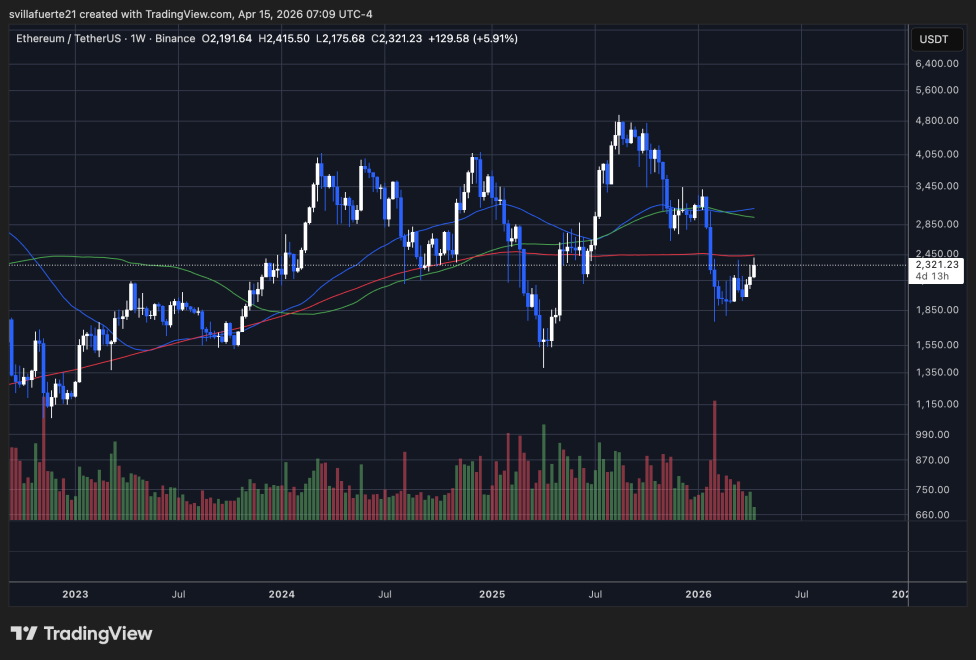
The February 2026 capitulation signaled a structural reset, and elevated volumes confirmed forced selling and massive risk aversion. Since then, ETH has made a recovery and is currently trading around $2,300-$2,400, a level that sits directly in an important pivot zone. This region previously acted as support from mid-2024 to early 2025, but is now being retested as resistance.
From a trend perspective, ETH remains below the 200-week moving average (red) and trending sideways, while the 100-week (green) and 50-week (blue) are converging just above the current price. This compression suggests that the market is nearing a decision point where it will have to regain these levels or face new downward pressure.
Since the capitulation surge, trading volumes have declined significantly, indicating that the recovery is not being driven by active inflows, but rather by a decline in sales.
If it sustains above $2,400, it will signal structural improvement. If it is rejected here, it is likely that a broader regime will be strengthened.
Featured image from ChatGPT, chart from TradingView.com
editing process for is focused on providing thoroughly researched, accurate, and unbiased content. We adhere to strict sourcing standards, and each page is carefully reviewed by our team of top technology experts and experienced editors. This process ensures the integrity, relevance, and value of your content to your readers.


