

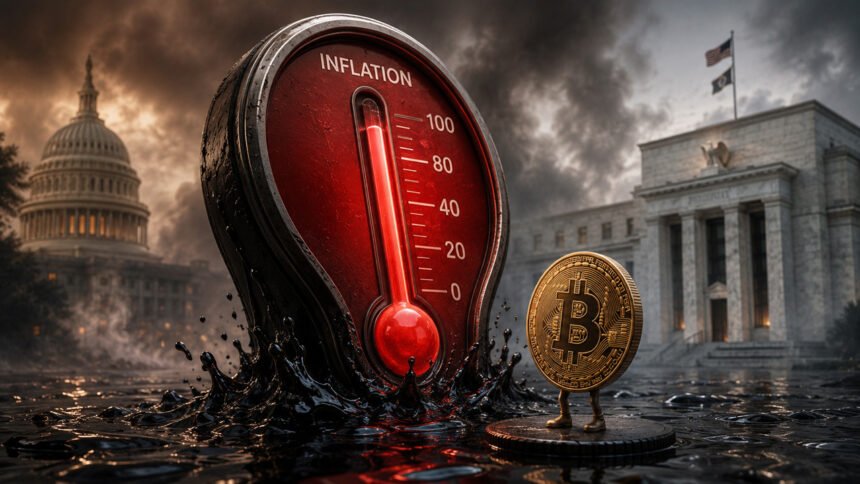


Bitcoin’s path to 2026 currently runs through global economic policy.
The turmoil around the Strait of Hormuz extends beyond commodity price events to government structures.
The International Energy Agency said exports of crude oil and refined products through the strait fell to less than 10% of pre-conflict levels in 2025, after about 20 million barrels a day, or about a quarter of global seaborne oil trade, passed through the route.
That’s the scale of the shock, which is no longer just a Brent chart.
The U.S. Energy Information Administration now expects Middle East production outages to average 7.5 million barrels per day in March, peaking at 9.1 million barrels per day in April, and global inventories to reach 5.1 million barrels per day in the second quarter. Brent crude oil prices are also expected to average $115 per barrel in the second quarter of 2026, before falling later in the year.
The question for Bitcoin is whether markets will view the oil shock as a factor that will keep inflation sticky and financial conditions tight, or as a shock severe enough to prompt governments and central banks to provide further support.
This bifurcation leaves Bitcoin with two defensible paths toward the end of the year. One is to return Bitcoin to high-beta collateral behavior due to liquidity pressure due to stagflation, or the other is to restore the scarce asset narrative through policy easing trading.

The shock also spills over into global economic policy.
The policy response is already clear. IEA member states agreed to release 400 million barrels from emergency stockpiles, the largest coordinated release in IEA history.
The White House has authorized 172 million barrels of supply from the Strategic Petroleum Reserve, and delivery at the planned release rate is expected to take approximately 120 days, according to the U.S. Department of Energy.
Adding supply elsewhere does not change the problem of scale. The eight OPEC+ members agreed to add 206,000 barrels a day in April, a move that could be significant at the last minute but is far below the disruption forecast currently built into the EIA’s outlook.
An even more important signal is the spread of emergency policies.
The IEA’s 2026 Energy Crisis Policy Response Tracker, updated on May 6, lists governments that are using conservation rules and consumer support to manage fuel stress.
Sri Lanka has introduced QR-based fuel rationing, South Korea has introduced odd/even driving restrictions and fuel price controls, India has set up LPG and fuel controls, Pakistan has set up measures for remote working and public transport, Japan has put in place fuel price caps through subsidies, Germany has set up fuel taxes and price controls, China has put in place price controls for refined oil, and the UK has put in place kerosene and industrial support.
A separate IEA demand-side report lays out options such as remote working, lower speed limits, public transport, car access restrictions, prioritization of LPG and reductions in air travel.
These measures are important for Bitcoin. This is because these measures move the oil issue from a market clearing issue to a policy response function.
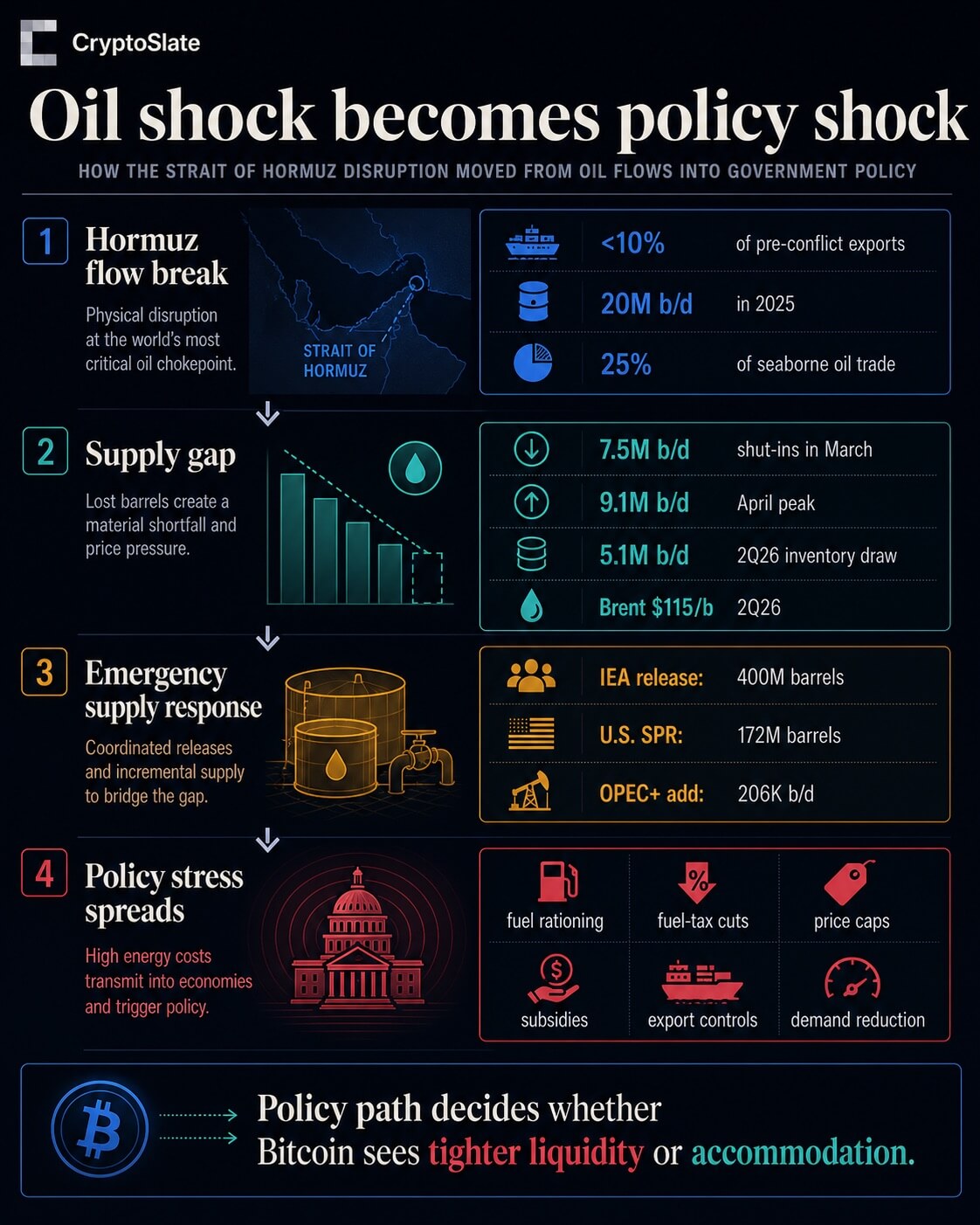
Macro signals become impure when governments cut taxes, cap prices, ration fuel, release reserves, or subsidize at-risk sectors.
Bitcoin is close enough to the key zone that this macro classification immediately becomes important. crypto slate According to Market Page, the price of Bitcoin as of May 12th was approximately $80,794, giving the broader cryptocurrency market a value of approximately $2.69 trillion and BTC’s dominance of approximately 60%.
Additionally, ETF inflows, geopolitical risks, US macro data, Fed signals, and oil stress continue to shape sentiment.
Flow still provides some treatment for the upward case, but it is not a completely clear signal.
According to the latest fund flow report, inflows into digital asset products totaled $117 million, marking the fifth consecutive week of positive flows. Bitcoin products had an outflow of $192 million, while Ethereum products had an outflow of $81.6 million.

The report notes that four days of outflows have been reversed by strong trading on Friday, making the flow situation look resilient but fragile.
Therefore, the $78,000 to $80,000 area is above trading levels in this setup. recent crypto slate Reports have linked this band to the Federal Reserve, oil-driven inflationary pressures, and Bitcoin’s struggles with on-chain supply levels.
If energy policy stress remains noticeable for Bitcoin, the market could argue that the ETF demand and scarcity narrative is absorbing the macro shock. Once we lose this region, the oil shock starts to look more like a real yield issue than a down trade.
Two paths define Bitcoin’s 2026 map
The downside path begins with EIA’s oil forecast becoming a macro base case rather than a temporary stress scenario.
Brent crude averaging $115 in Q2 2026, inventory withdrawals of 5.1 million barrels per day, and shutdowns of millions of barrels per day will continue to energize the inflation debate, even if preliminary releases soften the initial blow.
Governments can ease the pain with subsidies, tax cuts, price caps, direct aid to the sector, and fuel regulations. Such measures could also sustain demand, increase fiscal costs, and make it harder for central banks to treat shocks as clean, one-offs.
In this version of the year, interest rate cuts have been postponed, real yields have held firm, the fight against the dollar remains difficult, and Bitcoin trades as collateral for a risk book rather than a digital scarcity.
ETF demand is a notable transmission channel. While CoinShares’ Bitcoin inflow numbers show the bid is not going away, the mid-week outflow shows how quickly macro caution can dry up participants.
If energy inflation tightens Fed expectations and ETF flows weaken or reverse, Bitcoin doesn’t need a crypto-specific failure to fall. You just need a macro context to force risk aversion.
In this path, if you fail to hold $78,000 to $80,000, $76,000 to $78,000 becomes your first risk control zone.
A deeper reexamination of macro stress would put $70,000 to $73,000 in the picture. If forced sales and ETF redemptions intensify, the $62,000 to $66,000 area becomes a broader stress band.
These are not independent technical goals. These are price expressions of the market’s judgment that oil policy is tightening liquidity rather than creating it.

In the upward pathway, policy responses are classified differently.
In this version, the government absorbs energy shocks well enough that growth risks start to matter more than short-term inflation. Reserve releases, price caps, targeted aid, fuel tax relief, and demand reduction measures provide a bridge between shocks and eventual policy easing.
The market does not need central banks to ease immediately for it to start trading. Investors need to believe that real yields are falling, that the dollar is no longer acting as a wrecking ball, and that the policy regime is shifting from controlling inflation to protecting growth.
That’s when Bitcoin’s scarce asset story could return, especially if demand for ETFs continues to fall.
The latest CoinShares report does not prove that this path has won, but it does prove that this path is alive and well. Bitcoin attracted more inflows than digital asset products overall as Ethereum outflows and declining participation offset BTC demand elsewhere.
That discrepancy is important. This suggests that investors are still willing to isolate Bitcoin as a macro medium, even if participation in broader cryptocurrencies is uneven.
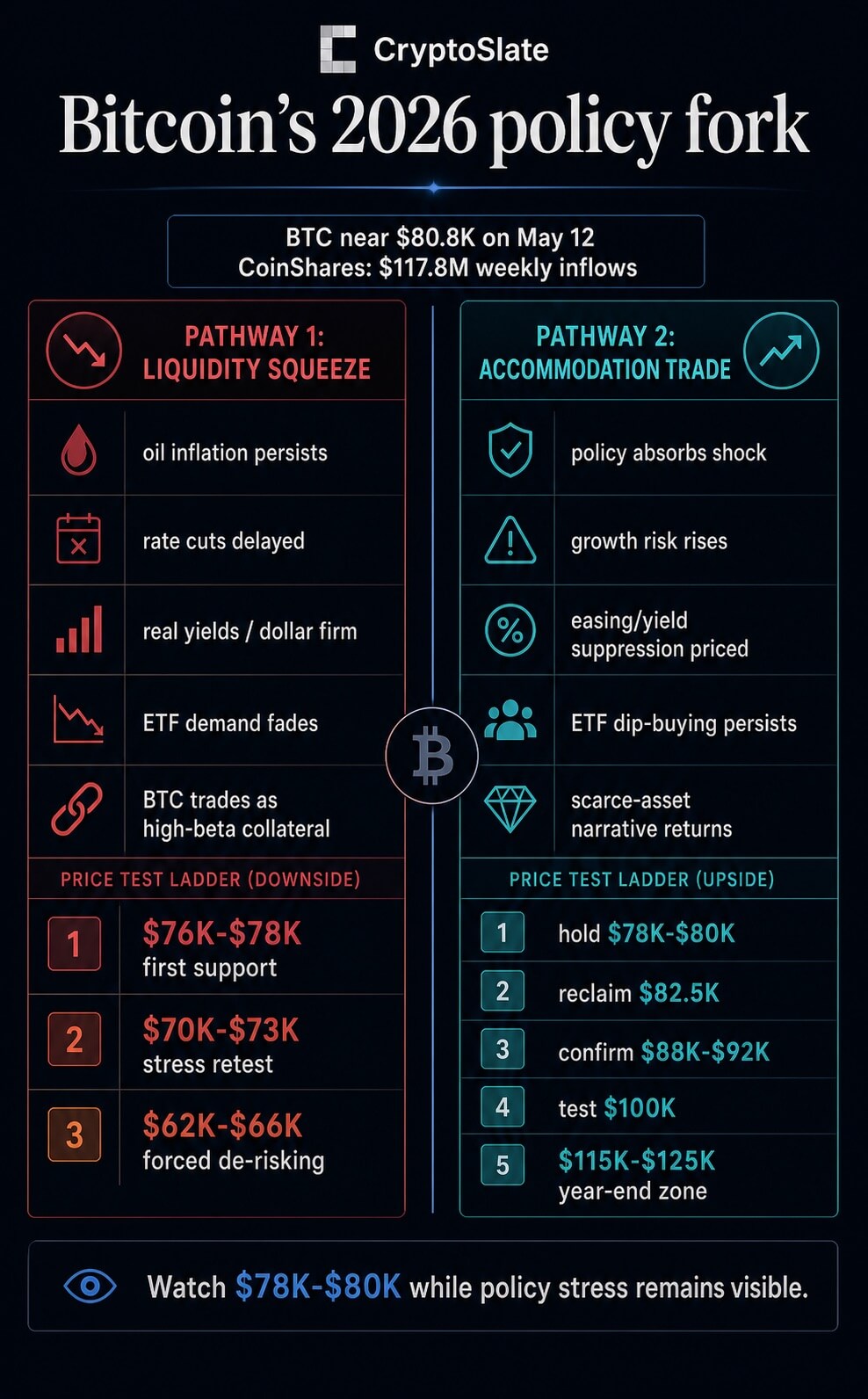
The confirmation ladder is clear. Bitcoin first needs to stay between $78,000 and $80,000. You then need to collect about $82,500, establish acceptance between $88,000 and $92,000, and test $100,000.
It will take more than a breakout off the charts to rally from $115,000 to $125,000 towards the end of the year. That will require continued accumulation of ETFs, easing pressure on real yields, and policy signals that translate energy bailouts into broader liquidity expectations.
This is a mirror image of the downside case. Subsidies, tax cuts, reserve releases and conservation measures that can keep inflation sticky could also be the first signs that policymakers will not allow shocks to crush demand.
If the market determines that policy support is greater than inflation resistance, Bitcoin will rise.
Policies and prices will be tested
Bitcoin does not need the oil market to return to normal before rising. The market needs to decide what the policy response means.
If energy remains expensive and policy continues to drive consumer spending, central banks will have less room to ease, and Bitcoin will remain vulnerable to a high-beta path.
If policy can absorb enough pain and shift the conversation to supporting growth, liquidity, and currency depreciation, Bitcoin has a path back to trading in scarce assets.
Therefore, live testing is simple but demanding. Bitcoin needs to remain in the $78,000-$80,000 region while oil stress manifests itself in government actions.
Holding that zone and getting back $82,500 would strengthen the adaptive pathway. Losing this would point to a crisis of stagflation, where oil policy creates a tough financial situation for Bitcoin to escape from.
(Tag Translation) Bitcoin


