


Shares of Strategy (formerly MicroStrategy) rose on Monday after the company approved up to $2 billion in share buybacks, opening the door to a Bitcoin sale to fund dividends, interest payments and buybacks, in a move to reassure investors that Bitcoin holders can meet their preferred stock obligations.
The company, led by Executive Chairman Michael Saylor, announced a new digital credit capital framework that will give management more room to protect its capital structure, which is under pressure due to the fall in Bitcoin and Strategy’s preferred securities trading below their stated values.
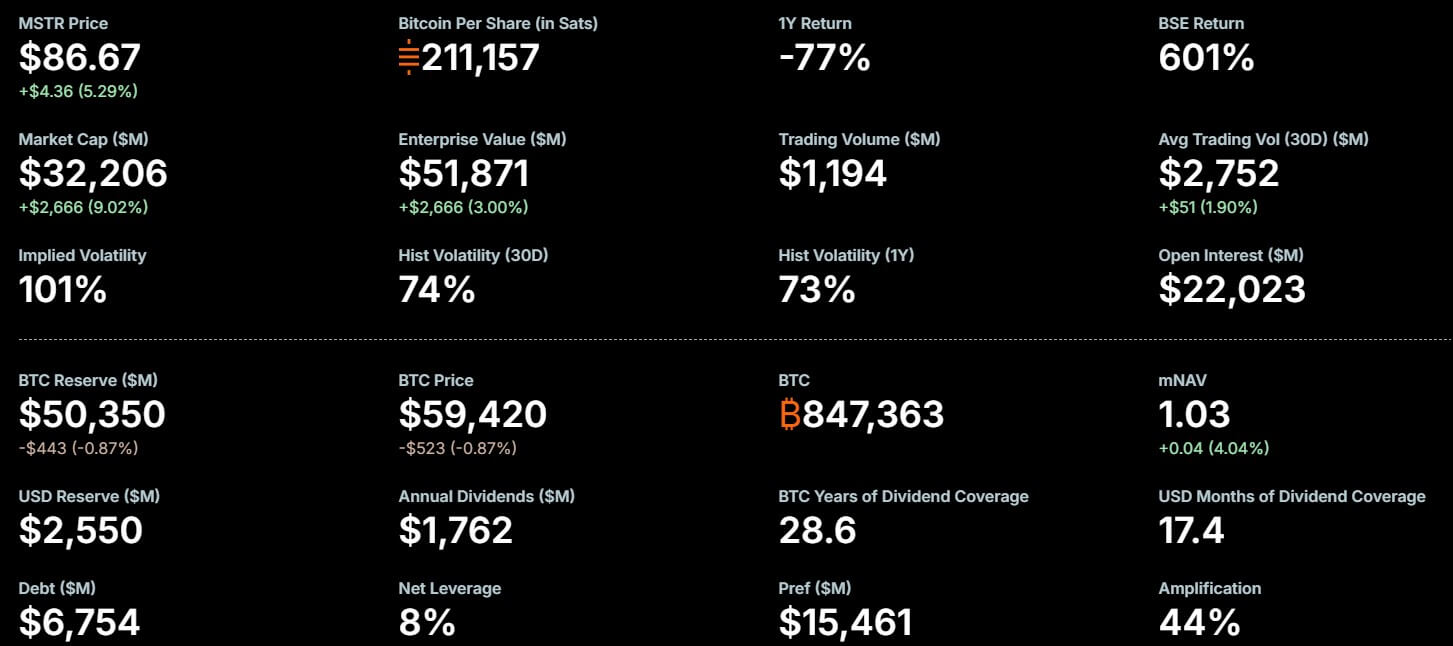
Following the announcement, MSTR rose 3.9% to $85.52 in early market trading, while distressed STRC rose to $81.
These price movements followed widespread declines in these stocks last week, when investors questioned whether the strategy could continue to rely on equity and preferred stock issuance to fund its Bitcoin strategy without putting pressure on existing shareholders.
The framework shows one of the clearest signs yet that Strategy is adjusting its strategy after years of fundraising to accumulate Bitcoin.
The company said it will continue to focus on Bitcoin as its primary financial reserve asset, but that it has formal authority to use a portion of its reserves as a source of liquidity should management determine that selling Bitcoin is more attractive than issuing common stock or other securities.
As of June 28, Strategy held 847,363 Bitcoins, worth approximately $50.7 billion. This position remains the largest Bitcoin holding by a company on the public market, but it also carries more than $13 billion in unrealized losses based on the company’s disclosed acquisition costs.
Build cash reserves with strategies
Strategy said its U.S. dollar reserves were approximately $2.55 billion as of June 28, including expected proceeds from shares sold through an over-the-counter offering program that has not yet closed.
The company said the reserves can only be used to pay dividends on preferred stock and interest on outstanding debt, unless the board approves a different use. Based on current annual preferred dividend payments and interest expense of approximately $1.76 billion, the reserves provide approximately 17.4 months of coverage.
The Board of Directors has also adopted a policy requiring Strategies to maintain minimum reserves equal to at least 12 months of expected preferred dividends and interest expense. Any move below this threshold requires board approval.
This reserve is intended to address one of the core concerns about Strategy’s funding model. Although the company’s Bitcoin holdings do not generate income, the preferred securities issued to fund the company’s Bitcoin accumulation come with periodic dividend obligations.
The company also said it has $1.25 billion of Bitcoin monetization capacity approved by its board of directors that can be used to build or replenish its reserves.
Combined with current cash reserves, Strategy said it has approximately $3.8 billion of current liquidity coverage for preferred dividends and interest expense, which equates to 25.9 months of coverage before repurchases, taxes, transaction costs, market conditions, or changes in dividend rates.
STRC dividend increases to 12%
Strategy also increased the annual dividend rate on its floating rate Series A Perpetual Stretch Preferred Stock, known as STRC, from 11.5% to 12%. This price increase applies to semi-monthly periods with a record date of July 1st or later.
STRC is designed to be traded in its vicinity. It was pointing to the $100 level, but is now well below that level. Recent market stress.
The security was trading around $81 at press time, and remains at a deep discount to par despite the company’s goal of returning it to the $99 to $100 range over time.
The company said it reviews STRC’s dividend rate monthly using factors such as the security’s trading level, market yields, credit spreads, Bitcoin price and volatility, reserve coverage, and broader capital market conditions.
Strategy also warned that it would not automatically increase STRC’s dividend just because the security is trading below a specified amount. Dividends are subject to board approval and are not guaranteed.
This distinction is important to investors who have treated STRC as a test of their faith in Strategy’s Bitcoin-backed credit model.
Higher dividends may help narrow the discount, but if market yields continue to rise or Bitcoin remains depressed, the cost of keeping the preferred stock complex stable will also increase.
Quinn Thompson, chief investment officer at Wrecker Capital, saw the announcement as a necessary response to recent market pressures.
Thompson noted that Strategy’s common stock has fallen nearly 30% in the past week, indicating increasing selling pressure. He characterized the decision to channel proceeds from the recent equity offering directly into the defense reserve as a very positive development for the agency’s trust.
But while Thompson expressed skepticism about whether a 50 basis point dividend increase would be enough to return STRC to its $100 par value, he acknowledged that the presence of a critical multibillion-dollar backstop has significantly stabilized the company’s overall capital structure.
$2 billion share buyback adds new lever
Strategy also authorized the repurchase of up to $1 billion of digital credit securities, including STRC, STRF, STRD, and STRK.
The company said STRC will be the initial focus of the program if management determines that share buybacks will increase and the capital structure will be strengthened.
Repurchases may occur through open market purchases, block transactions, tender offers, exchange offerings, or privately negotiated transactions.
The authorization does not require Strategy to purchase a specific amount of securities and does not have an expiration date.
The logic is simple. If the Strategy purchases preferred securities at a significant discount to the stated amount, it may reduce future dividend obligations while increasing the reliability of the remaining securities.
This could help reduce the cost of maintaining the company’s capital structure, but would also require the sale of cash or Bitcoin if the company were to raise funds outside of normal capital market activities.
Strategy also authorized a separate $1 billion repurchase program for its Class A common stock. The company said common stock repurchases may be utilized if management determines that MSTR is trading below its intrinsic value.
The company said the repurchases of both preferred and common stock will not be funded from U.S. dollar reserves. If Strategy uses Bitcoin sales to fund repurchases, those sales will be subject to the Bitcoin Monetization Program.
Chief Executive Officer Von Leh said the company is moving from a model that focuses on issuing securities to one that also buys back securities when it deems market prices attractive. He added:
“We intend to transition between issuing securities when capital is attractive and repurchasing securities when our products trade at levels that increase repurchases.”
Bitcoin becomes part of liquidity plan
Bitcoin monetization program is the most important part of the framework for long-term strategic investors.
Under this program, the company may sell Bitcoin for three purposes. One is to generate up to $1.25 billion in U.S. dollar reserves, fund or replenish cash to be used for preferred dividends and interest expense, and fund the repurchase of digital credit securities or MSTR common stock.
This program has no expiry date and requires no strategy to sell Bitcoin. Any sale is subject to market conditions, liquidity needs, taxes, accounting issues, legal requirements and management’s assessment of stockholder value.
Still, the approval formalizes a transition that has already begun. Strategy sold 32 Bitcoins for approximately $2.5 million between May 26th and May 31st, the second known Bitcoin sale in the company’s history.

While this sale was small compared to the company’s overall holdings, it demonstrated a willingness to use Bitcoin as a balance sheet tool if management believes it can improve its financial position.
The new framework extends that flexibility.
For years, Saylor’s strategy relied on turning public market demand for MSTR and related securities into a funding engine for Bitcoin purchases.
This model worked best when MSTR’s Bitcoin holdings were trading at a large premium to the value, allowing the company to sell stocks and preferreds and use the proceeds to buy more Bitcoin in what was described as an accretive management style.
That premium has shrunk rapidly. Strategy said it expects to remain disciplined in its use of common stock issuance, particularly when MSTR trades at or near 1x mNAV per share, a valuation metric associated with Bitcoin holdings.
The new framework gives executives another path. Rather than relying primarily on new issuance, Strategic can use cash reserves, Bitcoin monetization, and share buybacks to manage the debt generated by its own capital raising.
Despite the new possibility of selling BTC, Saylor said:
The strategy remains focused on Bitcoin as the primary treasury reserve asset. At the same time, digital credit requires liquidity, discipline, and active capital management.
(Tag Translation) Bitcoin


